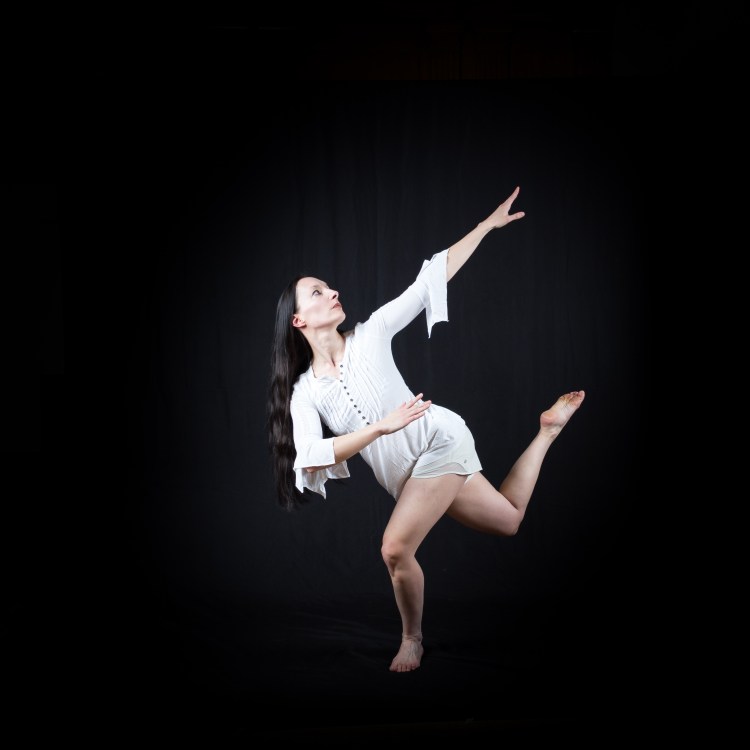
On this page we will talk about Martha Graham, what is Graham technique, and what to expect when attending a Graham class.
Martha Graham and modern dance
Modern dance emerged between the end of the 19th century and the beginning of the 20th century and is commonly perceived as a rebellion against ballet. Modern dancers wanted to move away from the rigid set of ballet moves and to create new movements that would express human feelings and human history in a more relatable and less conventional way.
Martha Graham was one of the pioneers of this dance style. She created a revolutionary mode of expression and a broad repertory, and is viewed as a genius and one of the greatest American artists. What distinguishes her from her contemporary dance innovators is undoubtedly her invention of a unique new system of dance training, along with a new formalised dance vocabulary, over the seven decades of her career. Her unique system was later called “Graham technique”.

Contemporary Graham technique and its benefits
Graham technique is based on four main principles: contraction, release, spiral and shift of weight. Properly performed, they all contribute to the dramatic effect of Graham work. The technique is not about the outside shape, the movement always starts from the core. The shape is initiated inside the body and it brings the outside shape with respect to all individualities. The use of the breath is also a fundamental component of Graham technique.
It is a powerful tool, both for amateurs and aspiring professionals. It gives dancers strong technical bases and enables them to become versatile. It also gives them the opportunity to find out what their own body has to express, to work on their artistry and to develop choreographic skills.
Unfortunately, Graham technique is often considered as outdated and not a part of today’s contemporary dance world. Nothing could be further from the truth. Graham herself said that “contemporary dance must remain contemporary and it must progress.” The technique was very different at the end of Martha Graham’s career from what it was at its beginning. It keeps evolving today as the Martha Graham School of Contemporary Dance trains new teachers and as dancers keep researching and deepening their technique.

What to expect in a Graham class
A typical Graham class always starts with some floorwork. Working on the floor enables to strengthen the spine and core without needing to worry about balancing. These exercises are essential in the technique and give Graham dancers a distinguishing movement quality, whether they sit, stand, fall, rise or travel. The floorwork is followed by standing exercises, a combination and/or travelling exercises.
In the following videos, you can watch a typical intermediate Graham combination starting with the Graham adagio (music by TALK), an advanced version of the Turns around the back exercise (music by Stahv Danker), an example of pliés in fourth position (music by Virginio Aiello & Vesislava) and an advanced version of the Exercise on 6 (music by Stahv Danker).
 Dance with Audrey